Navigation Pilot
Designing an AI-assisted navigation experience that helps drivers interpret uncertain road risks and make timely decisions — without losing control.
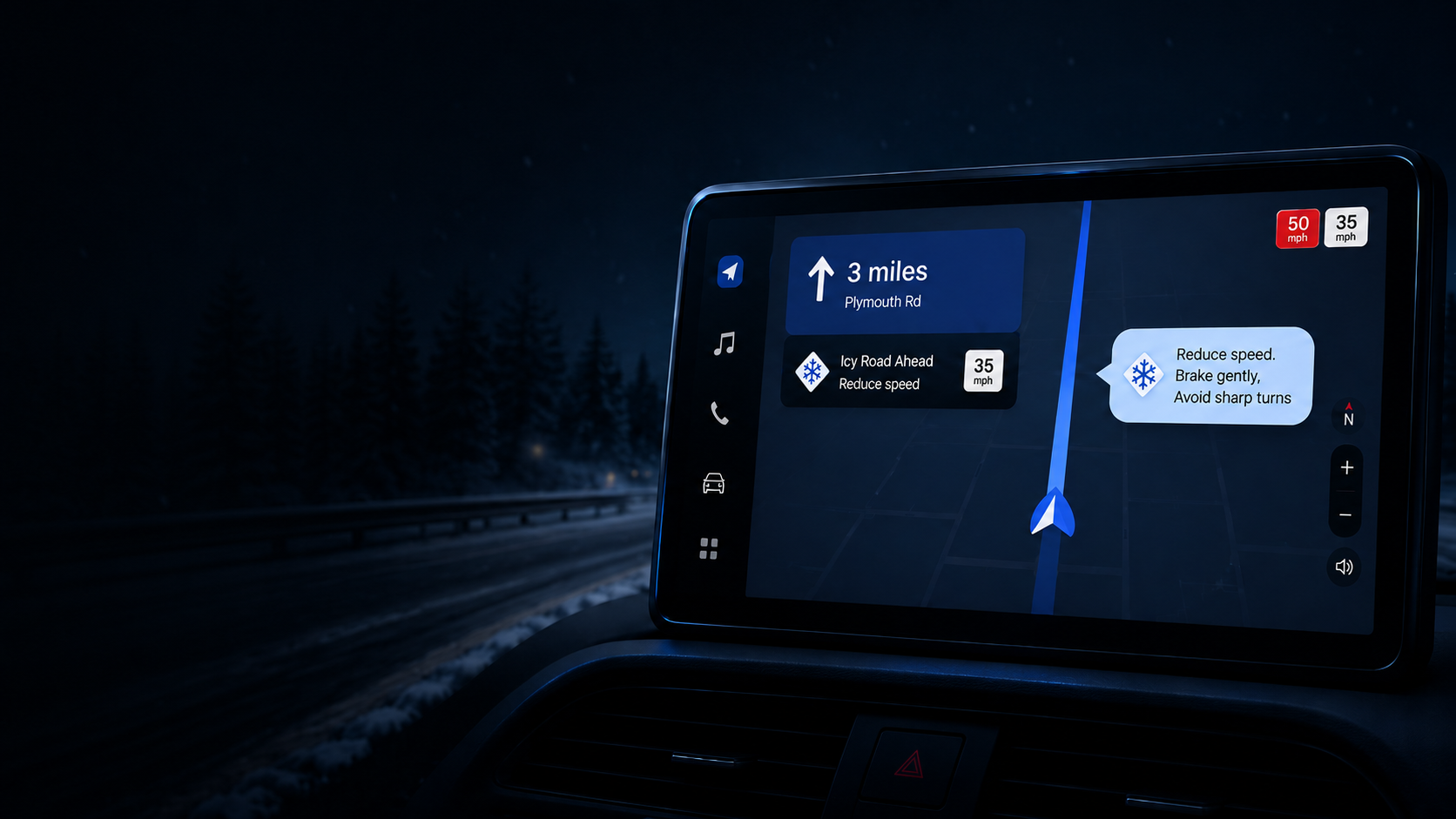
From route guidance to context-aware assistance.
Routes · Traffic · Turn-by-turn guidance
Road signals · Vehicle status · Route context
Watch the full concept in motion.
A 1-minute walkthrough of how Navigation Pilot helps drivers anticipate, assist, and reflect across the trip.
Predictive Guidance
Warns before road conditions become urgent.
Smart POI Recommendation
Suggests useful stops based on route and vehicle context.
Post-Trip Reflection
Turns trip data into clear feedback after the drive.
The challenge is not more information. It's knowing what deserves attention.
Drivers already manage routes, road conditions, vehicle status, and attention. Poorly timed assistance can become another source of cognitive load.
When attention is limited
Drivers cannot process every alert at once.
When decisions are time-sensitive
Fuel, parking, and route choices appear while driving.
When feedback lacks meaning
Trip summaries need explanation, not judgment.
How might we design a driving assistant that knows when to warn, assist, reflect — or stay quiet?
Four rules the assistant lives by.
Reduce cognitive load.
An alert that demands attention at the wrong moment is a liability, not a feature.
Intervene only when necessary.
Silence is the default. Every alert must earn its place in the driver's attention.
Preserve driver agency.
The system surfaces choices, not commands. Override is always visible and respected.
Build trust through transparency.
Every action includes a reason. No invisible behavior, no silent handoffs.
Predictive Guidance
Warn early, explain clearly, then get out of the way.
Detects upcoming road conditions, explains what to do next, and minimizes after the alert so guidance stays visible without taking over the screen.
Smart POI Recommendation
Recommend only when the context makes it useful.
Uses vehicle status and route context to recommend useful stops without pulling drivers out of navigation.
Post-Trip Reflection
Turn trip data into understanding, not judgment.
Turns trip data into clear, non-judgmental feedback after the drive.
What shaped the approach.
8 driver interviews
Drivers did not want more alerts. They wanted fewer interruptions, better timing, and explanations they could trust.
Key insight: Trust depends on relevance, timing, and clarity.
TomTom Virtual Horizon
Predictive road intelligence already existed. The design question was how to present it without increasing driver workload.
Key insight: Prediction only helps when it arrives at the right time.
Beyond route guidance
Exploring how road, vehicle, and route context can support decisions before, during, and after a trip.
Key insight: The challenge was not adding intelligence. It was earning attention.
Designing AI is not about showing more. It's knowing what deserves attention.
Navigation Pilot explores how predictive road data, explainable alerts, and restrained feedback can help drivers trust assistance without feeling overwhelmed.